



Reduced tourism and more vaccinations help lead to the mildest winter wave in years. Here’s more about what’s happening, and a reminder that while risks are low, they’re not nothing
Graphic by Matilda Bliss
COVID WAVE ALERT LIFTED — May 7, 2026
This is an ongoing series of alerts about covid risks in the Asheville area. Below the most recent updated, lifting the alert due to reduced risks. For clarity and further information, are previous alerts going back to the beginning of the current covid wave
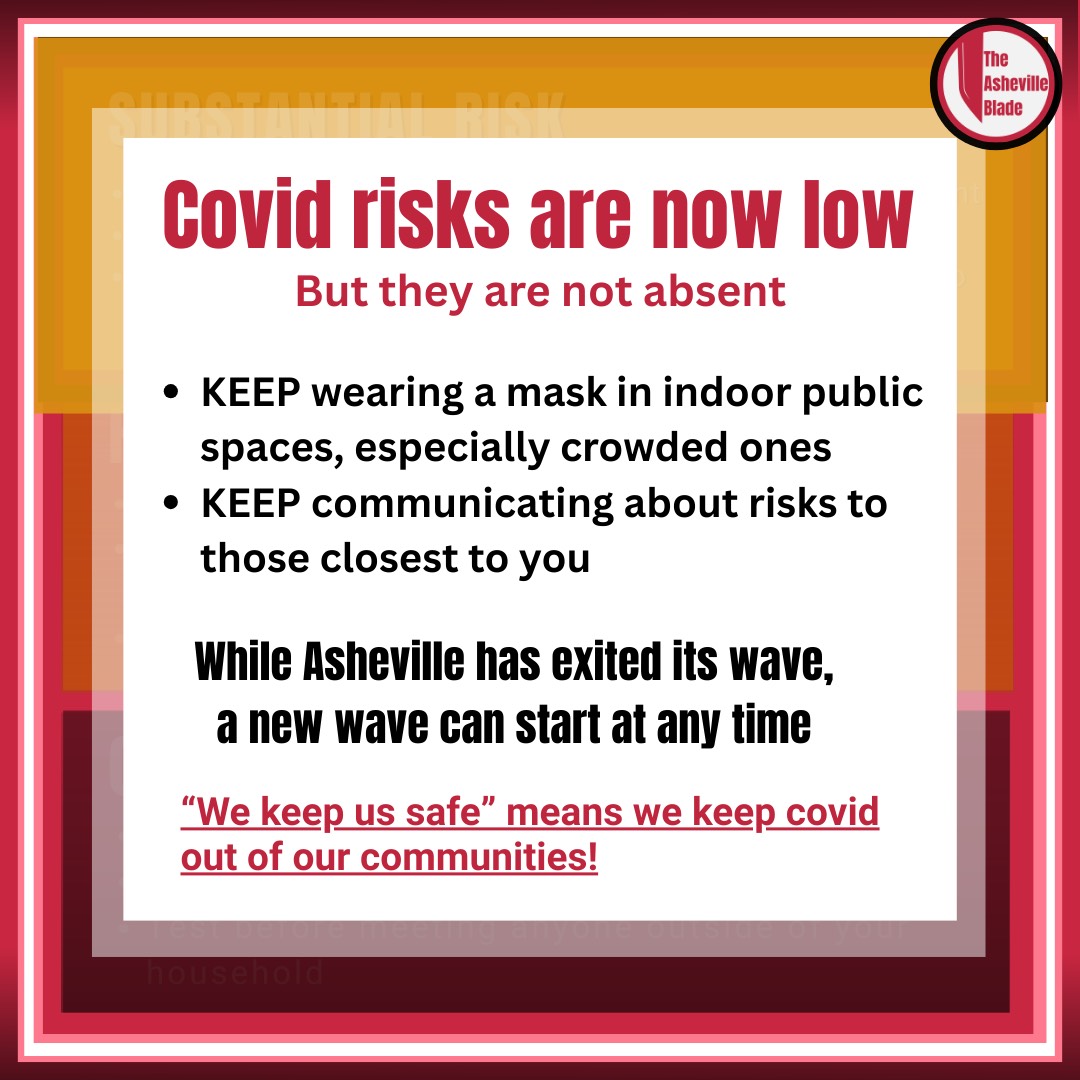
• Rare good news on the local covid front: driven by reduced tourism and increased vaccinations, this year’s winter covid wave was the mildest yet. Sharply reduced risks mean that we’re lifting the alert — for the time being
• However, low risk is not no risk. While reduced covid spread does mean locals can do more activities in relative safety, it does not mean risks aren’t still there. It’s still a good idea to mask up in indoor public spaces and have honest discussions about risks, especially with those who are more vulnerable
Readers, we’re in the fortunate, rare position of having genuinely good news on the local covid front. Back in January, we saw rates of covid in wastewater — the best remaining measure of local infection spread we’ve got — rise enough to indicate that we were, once again, in a covid wave.
This is, sadly, typical. Winters, since the beginning of the pandemic, have consistently seen some of the worst covid rates of the year, due to the holidays, increased tourism and more people crowding indoors.
But this year, fortunately, after risks rose to Substantial, they stayed there. This year’s wave was more of a tide, and for the first time ever we didn’t see sharply increased risks. Over the past few weeks risks declined further, indicating this relatively mild wave is now over.
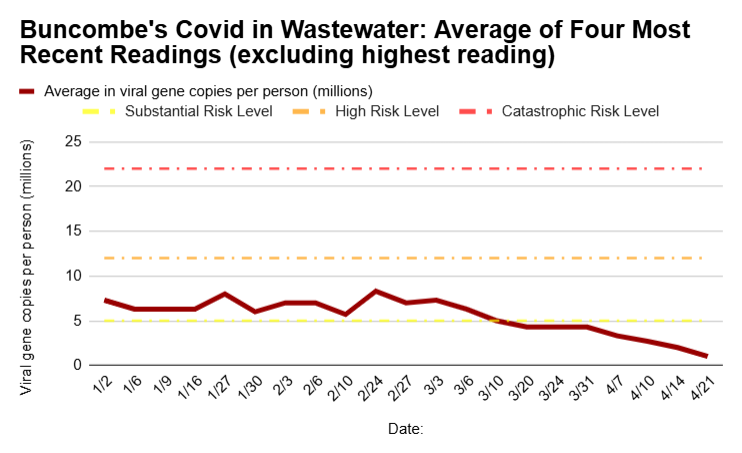
Graphic by Matilda Bliss
Measuring this hasn’t always been easy. The state public health data we rely on for these alerts has, over the past year, been more frequently late, incomplete or missing entirely. By this point, however, we’ve got enough to report this happy news.
What drove this year’s relatively mild winter covid rates? Tourism is, as usual, a major part of the answer. The industry, contrary to its marketing, drives increased infections by its very nature. High tourism drove Asheville’s multi-year, massive covid wave that began in 2022 and only truly ended after Helene.
But in the aftermath, covid rates have consistently remained lower due to decreased tourism. With that industry still lagging, the infections it usually drove remain substantially decreased as well.
Another factor is increased local uptake in the updated covid vaccines that came out last Fall. Ironically, attempts by the fascist federal government to stymie access backfired by drawing more attention to the benefits of getting one of these shots. When state officials made them more accessible, we saw more locals than in previous years lining up to get them. That meant less covid spread, and the increased awareness also drove more locals masking up and taking similar precautions during the winter.
However, the good news should be tempered by the fact that covid is still very much here. It is still a very good idea to wear an N95-level mask in indoor public spaces, especially crowded ones. It is still important to use mitigations like air purifiers and nasal sprays. It will always be important to honestly discuss covid risks with those around you, especially when they’re at higher risk of infection or danger if they contract it.
As we have before, we will revive these alerts if — likely when — covid rates spike again. We hope that won’t be for awhile. The more care and grounded precautions we all take, the more likely that will be.
As always: we keep us safe.
You can support the Blade‘s covid alerts — and everything else we do — by subscribing on Patreon, making a one-time gift to support our work or supporting our fund drive.
COVID WAVE ALERT — January 13, 2026
Graphic by Matilda Bliss
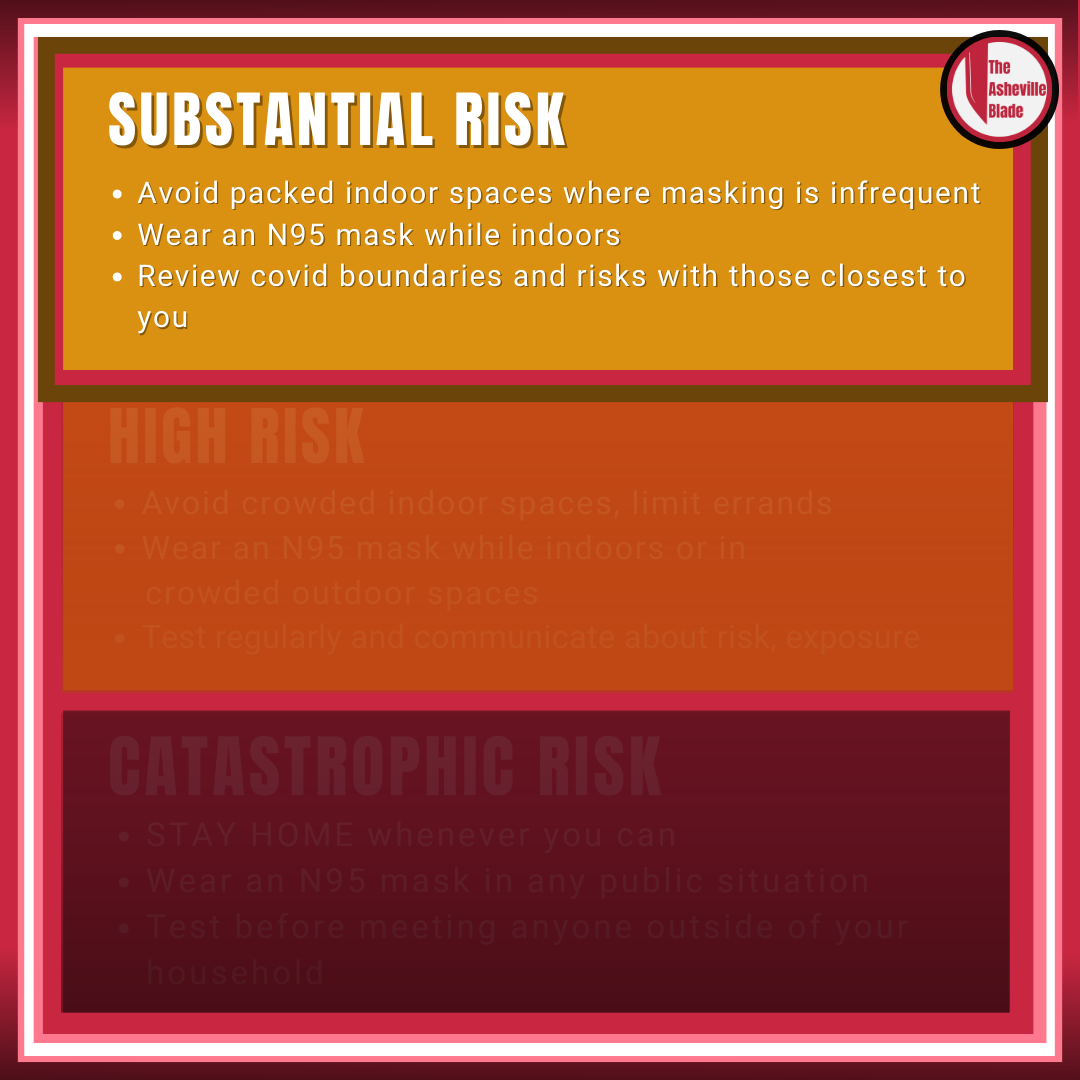
• While getting an accurate assessment of Asheville’s covid situation has proven frustratingly difficult the past few months, it’s now clear that infections are steadily rising. The post-holiday spike is here, ending a brief lull from the covid wave. While rates are, so far, lower than previous post-holiday time periods, risks are still worsening
• It’s necessary to exercise some caution and bolster one’s covid precautions. Avoid crowded indoor spaces with little masking, wear an N95 in indoor public spaces and review risks and precautions with those close to you. The more care we take now, the more this renewed wave can be blunted
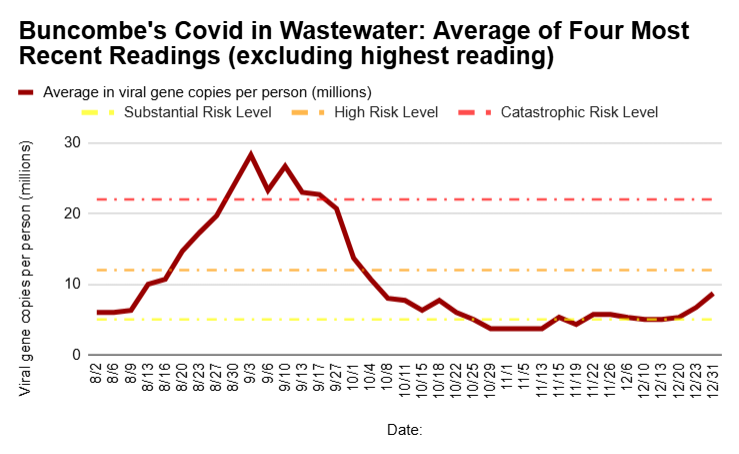
As has happened every year since the pandemic started, the post-holiday period’s seeing increased covid infections. After a lull in the covid wave late last year, rates — based on public virus in wastewater measurements — are now rising quickly.
So far — and those words are going to be very important in this update — the good news is that this post-holiday spike isn’t as bad as previous ones. Risks are Substantial, not the High or Catastrophic levels we’ve often seen by this time in previous years.
That said, the situation is moving in a notably worse direction.
Graphic by Matilda Bliss
We have to mention here that getting an accurate idea of the local covid situation has proven incredibly frustrating over the past few months, due to reporting issues with the data provided by the North Carolina Department of Health and Human Services. Virus in wastewater rates — the main measure of local covid spread we still have — have often been delayed, incomplete or some weeks entirely nonexistent.
When it was finally clear rates were right along the edge of a covid wave in late November we hesitated to lift the full alert here on our main site because we knew what was around the corner. Every single year since the pandemic started we’ve seen a post-holiday spike, often to the worst level of covid infections of the entire year. It’s not hard to see why: increased tourism and packed holiday events spread the virus and that means more people get infected and spread it to others.
So far, however, 2026 is a bit different. Reduced post-Helene tourism and increased mask wearing (also due to a particularly ugly flu strain this year) has helped curb the usual spike. So has — in a case of one disaster colliding with another — unseasonably warm weather that’s had more folks outdoors.
However, more arctic temperatures are now here, and rates are rising. This means that there is a notably increased covid risk from just a month ago. That, of course, means more precautions are needed.
Steps to take
With us well back into covid wave territory, activities that could be done in relative safety a month ago now carry a good deal more risk. Based on the level of infections we’re seeing, here’s some solid precautions to take.
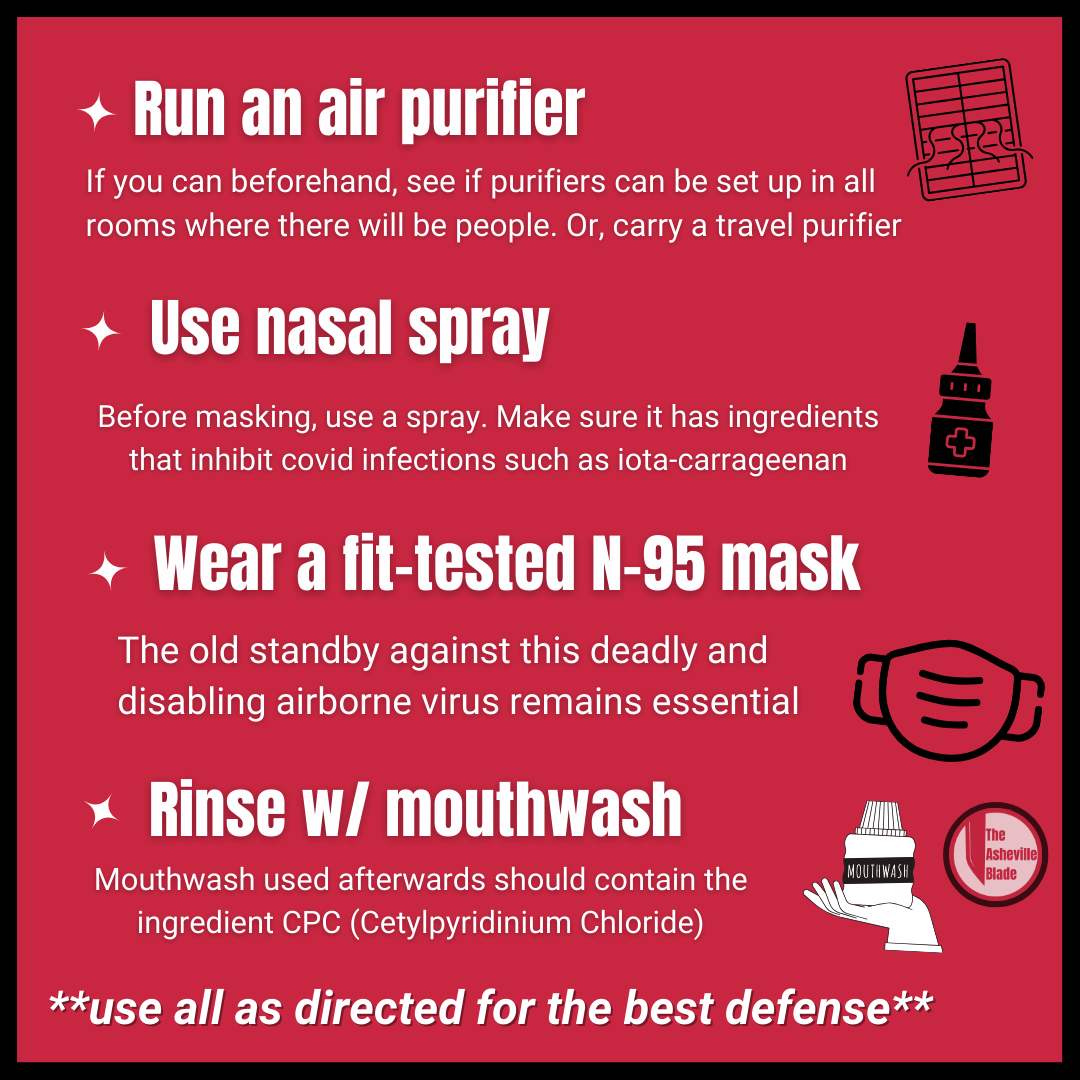
Wear an N95 in public places and use mitigations — These are, once again, particularly important. If you’re running an errand, going to work or end up in any crowded, indoor public space you should be wearing an N95-level mask. It offers substantial protection, even if no one else is masked, and helps keep you and others safe.
There are, fortunately, more ways to mitigate covid available than ever before. Air purifiers have improved dramatically over the past few years. Setting them up indoors — or having a travel purifier — can substantially reduce the spread of covid. If this city took the pandemic more seriously, you’d see them in just about every social space and we’d all be far safer.
Anti-covid nasal sprays, especially covixyl, can also offer another line of protection. So can rinsing, after potential exposure, with a mouthwash containing CPC (cetylpyridinium chloride).
Likewise, rapid tests remain a good precaution for close get-togethers with those outside your immediate household or circle. While they’re not always accurate, they still reduce risks and are especially helpful with rates increasing.
The Firestorm Cooperative in West Asheville still has free tests and mask available.
If you have the resources to get some extra tests or nasal sprays, stockpile them for your friends, neighbors and local mutual aid efforts. Consider working with others to get things like air purifiers as well.
Graphic by Matilda Bliss
Avoid highly crowded, maskless spaces — Given increasing infection rates, if a place is packed with maskless strangers it’s probably best to come back later, steer clear or get in and out quickly while masked.
On this note, it’s worth being more careful when holding wider get-togethers in your home. It’s a really good idea for everyone attending to take a rapid test and review covid precautions in advance.
Get the updated vaccine — While it has its limitations, the updated covid shot that rolled out last Fall is a key part of keeping yourself and others safe. The more of us that get it, the fewer people get covid and spread it to others.
Sadly, this is considerably more difficult than it used to be. The fascist cultists running major federal agencies have a raft of utterly delusional ideas about public health, and they’ve made it more difficult to access the latest covid shots, especially for people under 65.
Fortunately, a state-level standing order issued last year waives their requirement to have a doctor’s prescription to do so. Anyone over 65 can get it automatically, while anyone under can simply affirm that they have one of the many risk factors that make them more vulnerable to covid.
If you haven’t already — and too many still haven’t — get the updated shot however you can, as soon as you can.
Review covid boundaries and precautions with those close to you — It is a very good idea to have an honest conversation with those close to you about what precautions need to be taken and what your particular risks are, especially after the recent lull. “What’s your precautions?” needs to join the basic suite of questions when getting to know or getting together with someone. This can save a lot of grief down the road, and it’s really important for everyone to have a clear idea about what they need to do to keep each other safe.
Support higher-risk people — Higher-risk folks have faced atrocious treatment during the last few years of the pandemic.
Especially as rates rise, many spaces are unsafe for us. Even some groups in Asheville ostensibly dedicated to social justice don’t keep any basic covid precautions, even as infections rise. So make a point of helping higher-risk people you know out with errands, food and finding safe ways to socialize and keep in touch. A lot of us are about to face more isolation as risks rise and weather gets colder. Everything that counters that helps.
The fact this covid spike is, so far, not as bad as it could be is in part a testament to people taking increased precautions. The more of us do this, the sooner we’ll get through this. We keep us safe.
COVID WAVE ALERT — September 16, 2025
Graphic by Matilda Bliss
• As Asheville heads towards the height of tourism season and newer strains — combined with ridiculous restrictions on updated vaccines — lead to skyrocketing rates, covid risks in the area are rapidly increasing. Soon they’re likely to hit levels we usually see during winter.
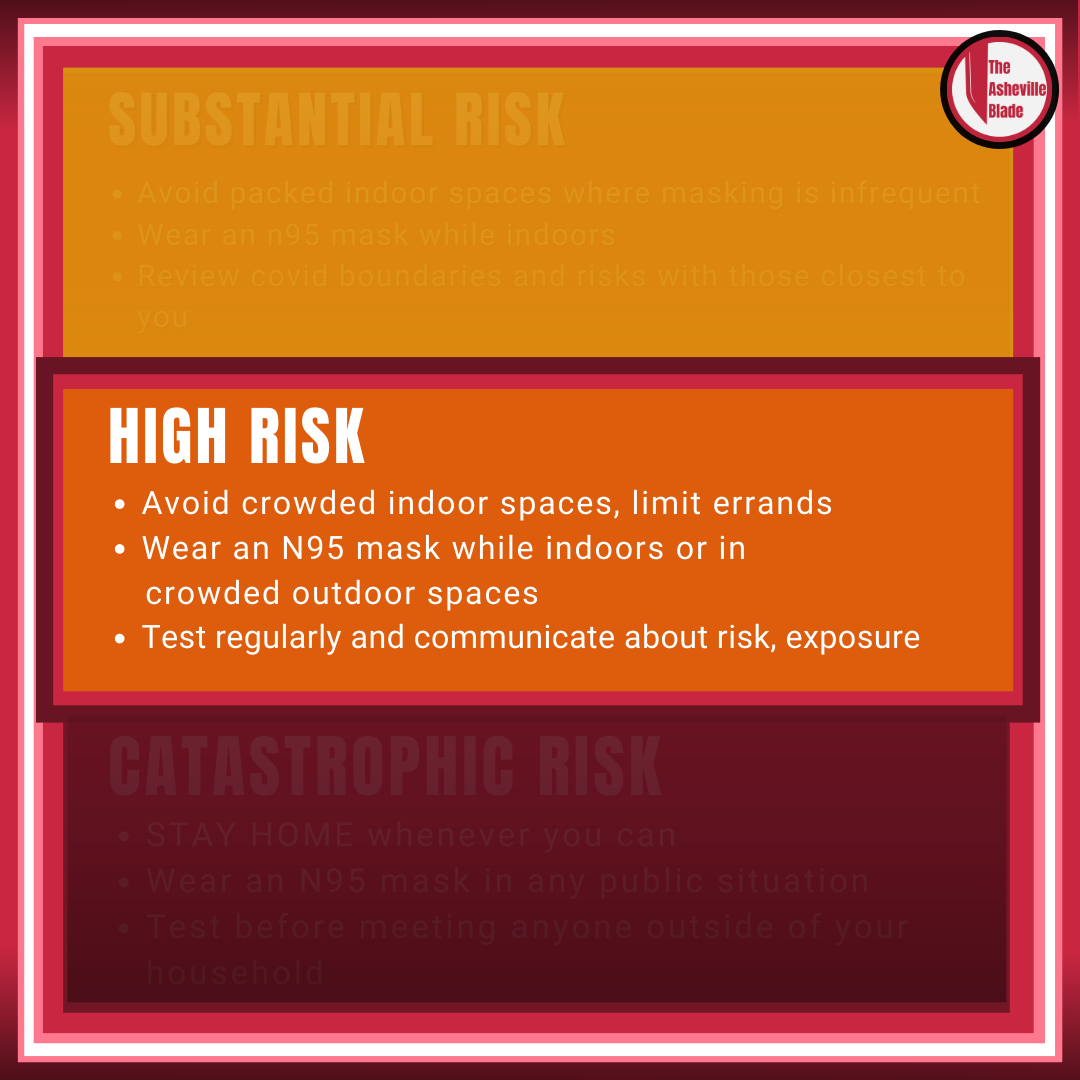
• It is now necessary to take stricter precautions. Limit errands and, when possible, avoid crowded indoor spaces. Wear an N95 mask in indoor public space and crowded outdoor ones. Test regularly, and make increased use of mitigations like nasal sprays and air purifiers. Get the updated vaccine however you can
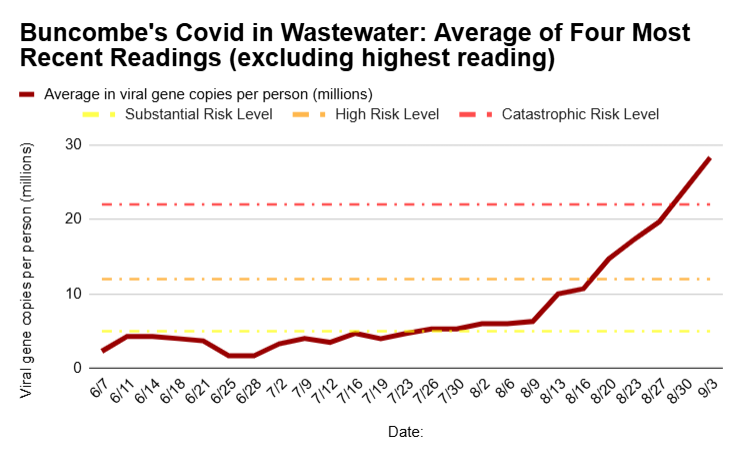
Regrettably, news on the local covid front has only gotten worse — a lot worse — since our last update. We are now at a HIGH risk level and rapidly heading towards a catastrophic one.
While tourism hasn’t rebounded to pre-Helene levels yet, heading into leaf season it’s increased enough to drive more infections and covid spread as we enter the Fall. Combine that with newer strains (places around the country are seeing increased covid infections right now) and ridiculous restrictions placed upon badly-needed vaccines by the fascists at the federal level and you’ve got a perfect storm for covid running rampant in Asheville.
The results are clearly visible in the latest virus in wastewater readings.
Graphic by Matilda Bliss
Particularly attentive readers may notice that the last part of the line has crossed into Catastrophic risk territory. So it’s worth explaining why we aren’t raising our alert to that level just yet.
Sadly, only two wastewater readings are taken each week for the state’s monitoring program. This means that, while very useful, virus in wastewater rates can be particularly prone to outliers. Because of that, the Blade requires at least two weeks of rates consistently being within a certain level to move our risk levels up (or down) and leaves out the highest reading of the past two weeks to get a more accurate picture, as best we can. Especially as this past week’s two readings were highly different (one barely into Catastrophic territory, the other well past it) we’re still getting more clarity on whether covid infections are starting to peak or continuing to skyrocket.
This is not a reason to relax. Given the factors at play, the latter scenario is more likely, and there’s decent odds we’ll get into Catastrophic territory pretty soon. Please understand we do the best we can with the (sadly limited) public health data we still have, and our methods are honed over three years of doing these alerts.
Steps to take
The key word at a High risk level, especially given the likelihood of the situation continuing to worsen, is caution. We’re not quite in “stay home whenever you can” territory, but there’s still very real risks of catching covid and spreading it to others if you let your guard down too much. Based on what we know those risks are getting worse, and will for some time to come.
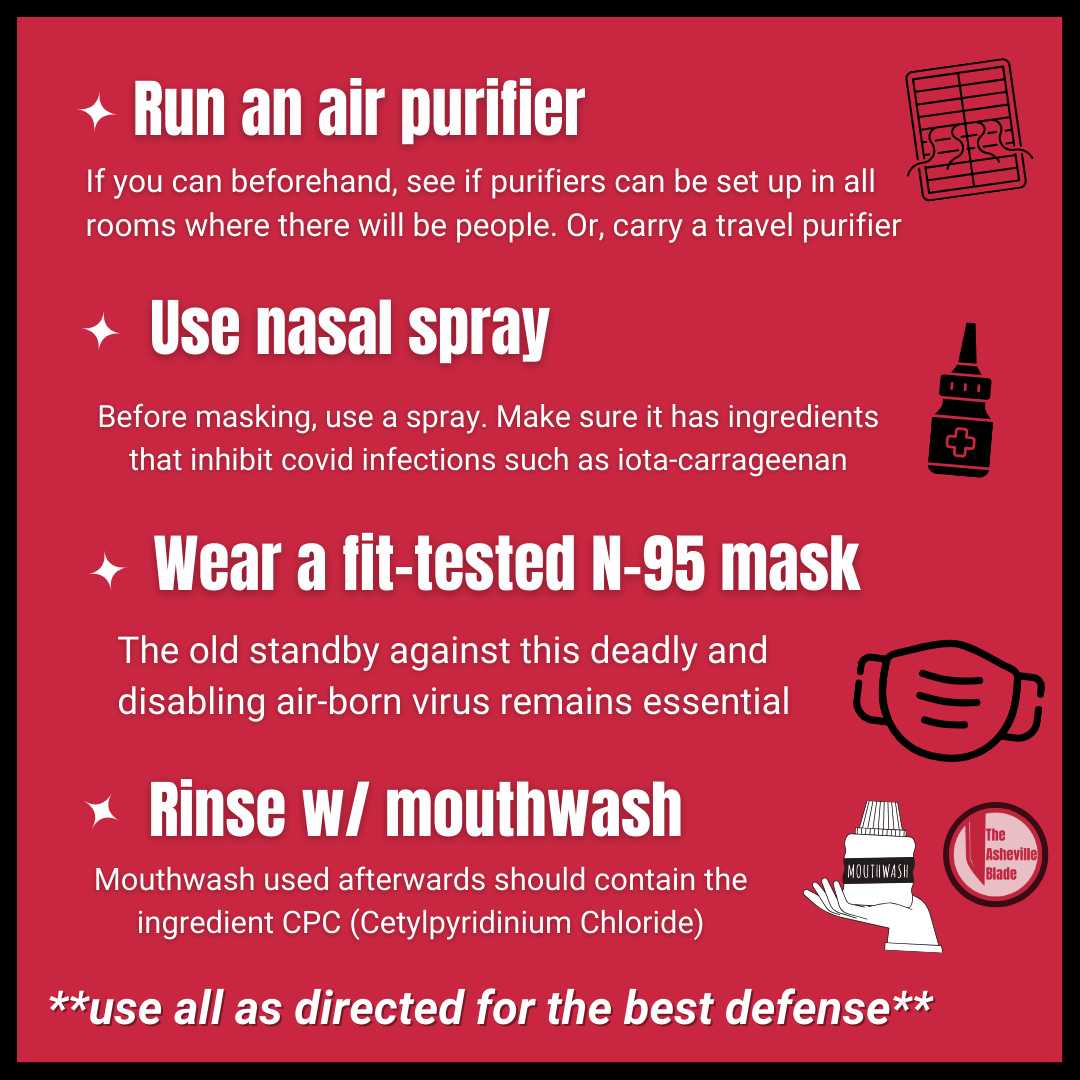
Wear an N95 mask. Test and use mitigations — Cloth and surgical masks don’t do much against the variants currently circulating. It’s especially important to wear a well-fitting N95-level mask (or better) in public indoor spaces and crowded outdoor ones. While outdoors events are far safer than indoor ones, covid can and does still spread there with prolonged exposure. It’s generally a good idea to wear an N95 any time you come into close contact with others outside those you live with or outside of small groups taking careful precautions.
While it’s certainly really helpful if everyone in a place is wearing a mask, N95s offer substantial individual protection even if no one else is. They are essential right now.
There are, fortunately, more ways to mitigate covid available than ever before. Air purifiers have improved dramatically over the past few years. Setting them up indoors — or having a travel purifier — can substantially reduce the spread of covid. If this city took the pandemic more seriously, you’d see them in just about every social space.
Anti-covid nasal sprays (like covixyl) can also offer another line of protection. So can rinsing, after potential exposure, with a mouthwash containing CPC (cetylpyridinium chloride).
Likewise, rapid tests remain a really good precaution for close get-togethers with those outside your immediate household or circle. Especially with rates increasing, they’re essential during uncertain periods like this.
If you are in a circumstance where you might have been exposed, take a rapid test at least three days after and isolate as much as possible until then. If you’re getting together in close quarters with people you don’t usually live with, everyone testing beforehand is a very good idea.
Graphic by Matilda Bliss
Get the updated vaccine — While it has its limitations, the updated covid shot is a key part of keeping yourself and others safe. The more of us that get it, the fewer people get covid and spread it to others.
Sadly, this is considerably more difficult this year. The fascist cultists running major federal agencies right now have a raft of utterly delusional ideas about public health, and they’ve made it more difficult to access the latest covid shots, especially for people under 65.
Fortunately, a state-level standing order now waives the requirement to have a doctor’s prescription to do so. Anyone over 65 can get it automatically, while anyone under can simply affirm that they have one of the many risk factors that make them more vulnerable to covid. There is a chance federal agencies restrict it even further in the coming weeks, but for now that’s where things are.
Get the updated shot however you can, as soon as you can.
Avoid crowded indoor events, dining and drinking — The fact this isn’t particularly popular doesn’t mean it’s not necessary. Given where rates are it’s a really good idea to avoid being maskless indoors around a bunch of strangers whenever you can.
Sadly, even in more ostensibly left-leaning communities people are still facing a lot of pressure to come, unmasked, to risky events. That does not change the hard fact that this precaution is a very important one to take.
Limit errands — Given the rapidly-increasing rates, it’s worth keeping errands, when you can, to curbside pick-up or delivery. If you do need to go into a store — and many of us will from time to time — wear an N95 and make it quick. If you can time it for a less busy part of the day, do.
This can obviously be difficult for many of us in a city with this much poverty. We struggle with that too. Coordination can help, with several friends or community members going in on obtaining supplies and helping to distribute it to each other. There’s never a time when mutual aid doesn’t matter.
Stay vigilant and communicate — Uncertain times like this are tricky during a pandemic, as we adjust to a quickly changing, and probably worsening, situation.
Odds are you will face pressure to ignore the obvious, from the information we share above to those you know getting sick. You will hear that “no one” is wearing a mask and taking basic precautions anymore, especially in the face of the other crises our city and society face. Don’t believe that. If the past few years have given our communities anything, it’s the hard lesson that ignoring things does not make them go away.
Instead talk to each other, be clear about what the risks are right now and what you and those close to you need to do to navigate this wave. If someone’s doing something dangerous, even unintentionally, say so. Many of us live with others with a variety of risk levels, and it’s important to be honest so we can all figure out how to best navigate that.
If you need help with something, ask. If you think someone you know might need help, ask them. Check in on higher-risk folks you know (including if you’re higher-risk yourself) and see how their needs can be met.
Sadly, more crises hitting our communities — from fascist governments to the ongoing aftermath of Helene — does not mean others go away. Covid remains a real danger to yourself and others. In Asheville that danger is getting worse, and every action we take to fight it matters.
COVID WAVE ALERT — August 21, 2025
Graphic by Matilda Bliss
• After three months finally out of a years-long covid wave, rising tourism has spurred quickly rising covid rates. Especially with school about to resume it’s clear Asheville is, once again, in another covid wave
• Basic precautions go a long way towards preventing infection for yourself and others around you. Avoid packed indoor spaces with little masking, wear an N95 mask while indoors and use mitigations like nasal sprays and air purifiers. It’s also a really good time to discuss risks and precautions with those close to you.
Sadly, Asheville, we once again have to be the bearers of bad news on the local covid front. Public health data shows that we are, after a very welcome break, once again in a covid wave.
On May 20 our area, for the first time in about three years, finally exited a covid wave. A wave is defined by public health data indicating a substantial (or worse) amount of ongoing infections. While, as we’ve emphasized frequently, covid certainly doesn’t go away when rates dip below a wave, the risk of infection and spreading it to others are seriously increased during one. It means it’s time to be more careful, with more specific risk levels depending on how bad the wave is at a specific time.
A major increase in tourism and the widespread abandonment of even basic precautions fueled the long covid wave that started in 2022. The post-Helene decline in tourism, always one of the major drivers of the Asheville area’s unusually high covid rates, finally saw us exit the wave just over three years later.
While declining tourism may have the gentry, hotel barons and the establishment media in a panic, the sharply reduced covid levels gave locals a much-needed reprieve.
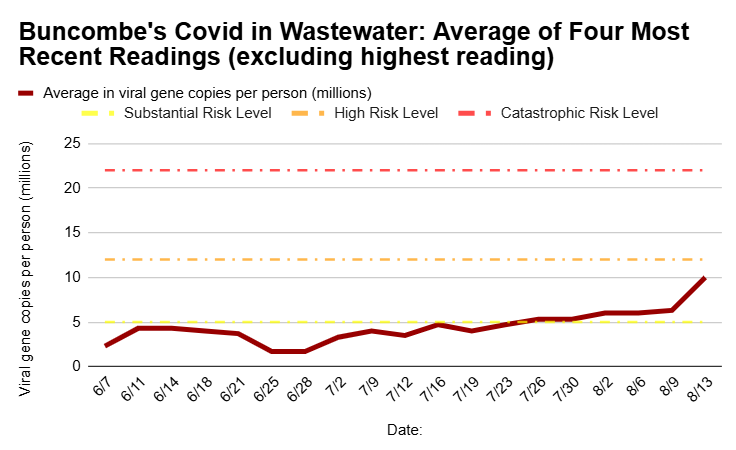
So, what changed? We’re heading towards leaf season, which means Asheville’s annual tourism cycle is about to hit its peak. While the covid rates we’re seeing are currently well below what we did in previous tourist-laden summers, they’re still rising enough to once again be a more serious problem. As you can see below.
Graphic by Matilda Bliss
That graph is based on virus in wastewater, the main measure of local covid spread we have left. It shows a clear pattern of rising rates starting a few weeks back. Recent results make it clear that we’re into another covid wave. Combined with the looming resumption of school, another major driver of infections, there’s good reason to alert the public.
Of course, the national environment has become even more hostile to fighting this still-debilitating (and deadly) virus. The fascist cultists currently running major federal agencies are scrapping badly needed research programs, spouting delusional lies and pushing to make vaccines even harder to access.
That means it’s more important than ever for us to do what we can on the ground. Keeping our communities safe, taking basic precautions and refusing to ignore the reality of covid are significant acts of resistance.
Steps to take
With us well back into covid wave territory, activities that could be done in relative safety a month ago now carry a good deal more risk. Based on the level of infections we’re seeing, here’s some solid precautions to take.
Wear an N95 in public places and use mitigations — These are, once again, particularly important. If you’re running an errand, going to work or end up in any crowded, indoor public space you should be wearing an N95-level mask. It offers substantial protection, even if no one else is masked, and helps keep you and others safe.
There are, fortunately, more ways to mitigate covid available than ever before. Air purifiers have improved dramatically over the past few years. Setting them up indoors — or having a travel purifier — can substantially reduce the spread of covid. If this city took the pandemic more seriously, you’d see them in just about every social space and we’d all be far safer.
Anti-covid nasal sprays, especially covixyl, can also offer another line of protection. So can rinsing, after potential exposure, with a mouthwash containing CPC (cetylpyridinium chloride).
Likewise, rapid tests remain a good precaution for close get-togethers with those outside your immediate household or circle. They’re especially helpful with rates increasing.
The Firestorm Cooperative in West Asheville has free tests and mask available.
If you have the resources to get some extra tests or nasal sprays, stockpile them for your friends, neighbors and local mutual aid efforts. Consider working with others to get things like air purifiers as well.
Graphic by Matilda Bliss
Avoid highly crowded, maskless spaces — Given sharply increasing infection rates, if a place is packed with maskless strangers it’s probably best to come back later, steer clear or get in and out quickly while masked.
On this note, it’s worth being more careful when holding wider get-togethers in your home. Having a summer party? Plan now for everyone attending to take a rapid test and review covid precautions in advance.
Review covid boundaries and precautions with those close to you — It is a very good idea to have an honest conversation with those close to you about what precautions need to be taken and what your particular risks are, especially as we just had a prolonged period of far less covid spread. “What’s your precautions?” needs to join the basic suite of questions when getting to know or getting together with someone. This can save a lot of grief down the road, and it’s really important for everyone to have a clear idea about what they need to do to keep each other safe.
Support higher-risk people — Higher-risk folks have faced atrocious treatment during the last few years of the pandemic.
Especially as rates rise, many spaces are unsafe for us. Even some groups in Asheville ostensibly dedicated to social justice don’t keep any basic covid precautions, and probably won’t even as infections sharply rise. So make a point of helping higher-risk people you know out with errands, food and finding safe ways to socialize and keep in touch. A lot of us are about to face more isolation. Everything that counters that helps.
While this isn’t the news we’d like to bring — we were certainly enjoying the past few months of reduced covid risks as well — it’s the reality of what our communities are up against. The more we face it, and help each other, the better off we’ll all be.
—
The Asheville Blade is entirely funded by our readers. If you like what we do, donate directly to us on Patreon or make a one-time gift to support our work. Questions? Comments? Email us.