


Over a year after Helene, past all the glossy marketing, this is a city deeply marked by disaster. Beneath the ruins dotting the landscape an even more dire human tragedy is unfolding. The beginning of a Blade series on the crisis after the crisis, and how it got that way
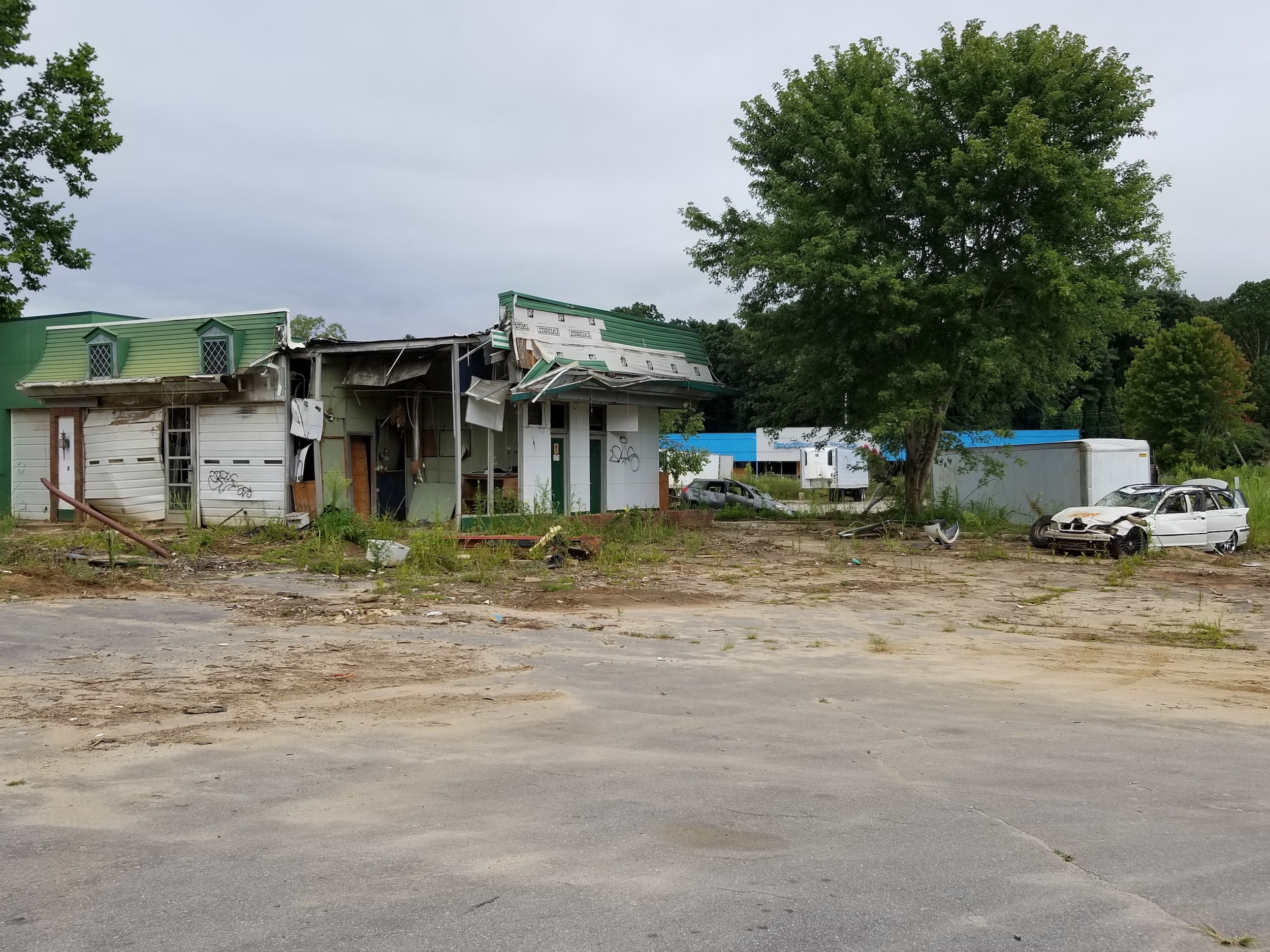
Above: A shattered building in East Asheville, with destroyed vehicles still around it. Photo taken in August
This is the first part of The Crisis After the Crisis, a series on the realities of Asheville after Helene
There is a reality that’s hard to convey to anyone that hasn’t spent a significant amount of time in the Asheville area since Helene. While I’m going to use words and photos to, as best I can, give a glimpse, it’s really not something one grasps until you see it up close.
You can drive through sections of the city that, at least on the surface, seem mostly recovered. Lights are on, people are out. Any debris or visible sign of the storm is nowhere to be seen, at least at first.
But then you’ll turn a corner or take a side road, and you will run into ruins.
There are spots like this all over the area: annihilated buildings, wrecked cars, places where the devastation looks like it took place just weeks ago. While there are, of course, not as many as before, there’s a whole hell of a lot more than one might think. Because the gentry’s greed did not take a break, occasionally you’ll even see a shiny “for lease” sign outside.
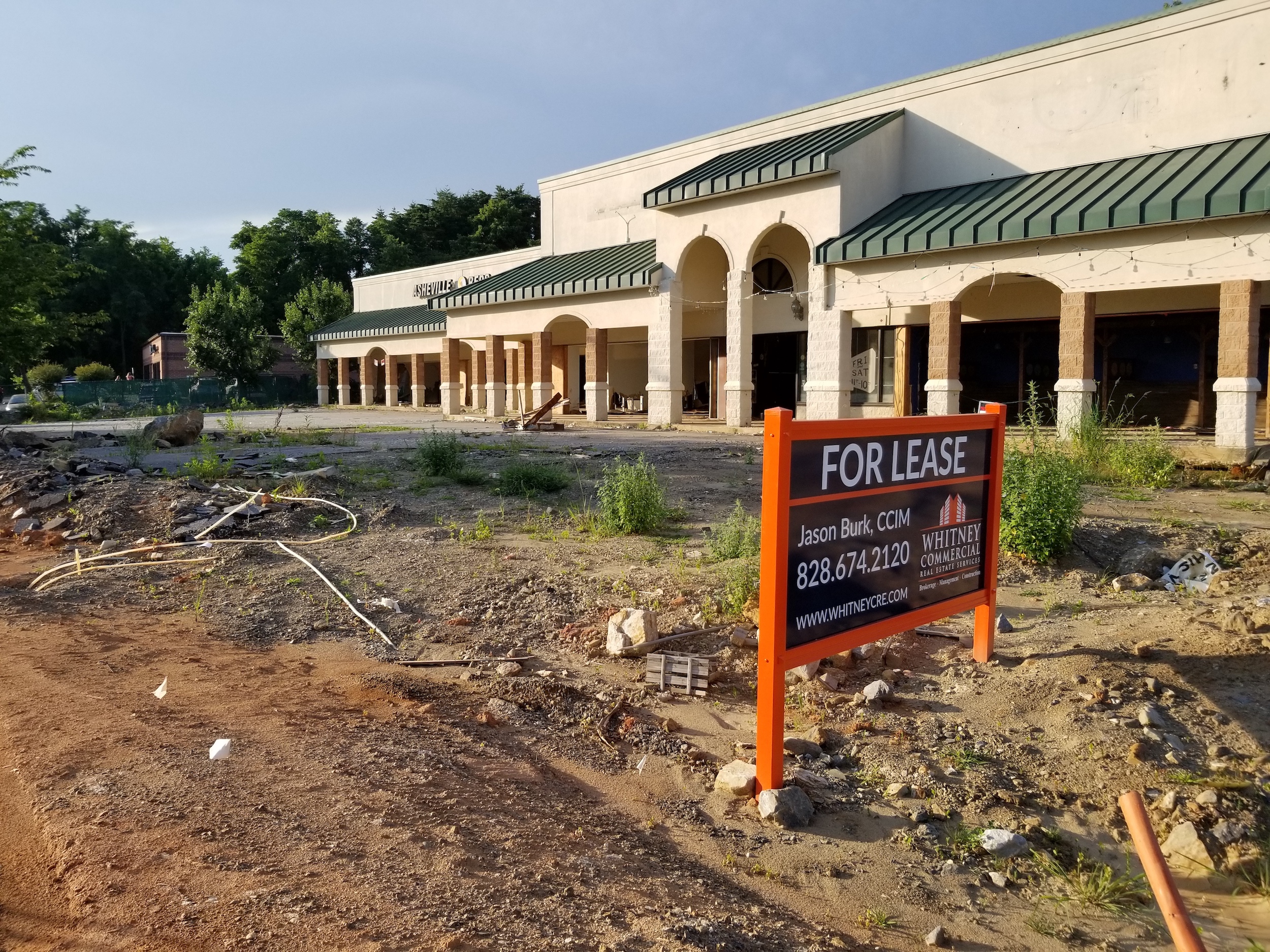
A ruined shopping center on Tunnel Road this summer, already offered for lease
The geography of the mountains channeled the sheer devastation of Helene in fragmented, sometimes unpredictable ways. A relatively unscathed area could be less than a mile from one hit with apocalyptic devastation.
The anniversary of the storm passed late last month. Alongside memorials that were sincere grapplings with the grief and trauma we all face, there was the heavy drumbeat of officially-sanctioned marketing and ceremonies. As these have faded over the past few weeks, the sights above have remained heavy on my mind.
Asheville is, bluntly, not what they’re presenting it as. Even the very real heroism of people on the ground, of the disaster relief and mutual aid efforts, are conscripted to serve an official narrative of a city where everything is just fine (and everyone should shut up and smile so the tourists come back).
But the ruins that still lurk, just off the main drag, are a small harbinger of a much deeper human crisis. One that, even as some of the shattered buildings are finally torn down bit by bit, is getting worse.
Asheville is a place where people made homeless by the storm still live out of their cars, violently persecuted by local governments and elites. It is a place where the same gentry who bragged “Asheville Strong” started evicting people even before the water was back on. Where the desperation of the same locals whose heroism was once so loudly praised is ignored in favor of making the rich richer. Where the firefighters who saved so many lives are still badly underpaid while city hall — with the unanimous approval of city council — gave top officials massive raises and hit locals with a major tax hike to appease wealthy investors.
This is a place where the powers that be are hellbent on building things back exactly as they were, exactly where they were, pretending there will never be another major storm on the horizon.
Asheville is still a disaster zone.
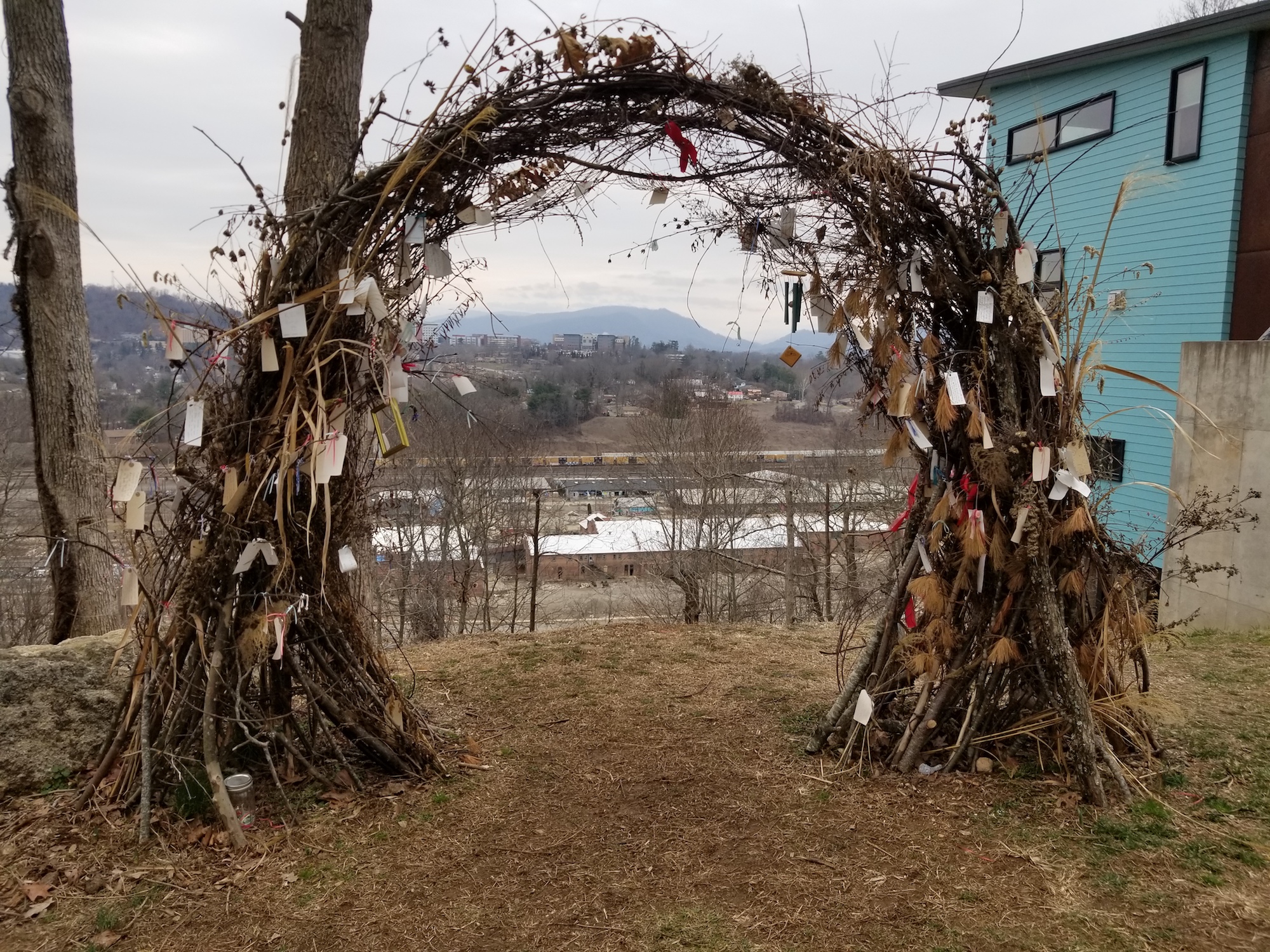
The “Grief Gate” local art on a side street overlooking the river district. Locals wrote their griefs and hopes after Helene on the slips of paper hanging from its branches. Photo taken in February.
You wouldn’t know it by the (often tinged with desperation) marketing blitz that accompanied the year anniversary of the storm hitting our city.
Good Morning America, a show that’s played a repeated role in Asheville’s tourism machine for well over a decade, was one of the worst offenders. On Sept. 18 they arranged groups of locals in front of the Biltmore Estate. Amid the sunny image of recovery presented by the segment, correspondent Janai Norman repeatedly invoked the narrative the gentry want pushed to the wider world.
“We’ve got to get those tourists back.”
While some segments on the show — especially in the past — featured local aid groups, the Helene anniversary segment revolved around an interview with Chase Pickering, vice president of the Biltmore House and a scion of a family whose wealth goes so far back it predates the country. At the end Norman again emphasized the need to “bring back the tourists.”
It must be remembered that this broadcast to the world took place not at a community center or public park, but at the largest private home in the country, built by robber barons and still operated for the personal profit of their spoiled heirs. The cash that the Biltmore Company donated in the wake of Helene is, as these things always are, a fraction of a fraction of their wealth.
But on that morning in September, less than a mile away from that giant mansion, destroyed buildings lurked behind tourism industry wrap proclaiming “it takes a village” and “Visit NC.”
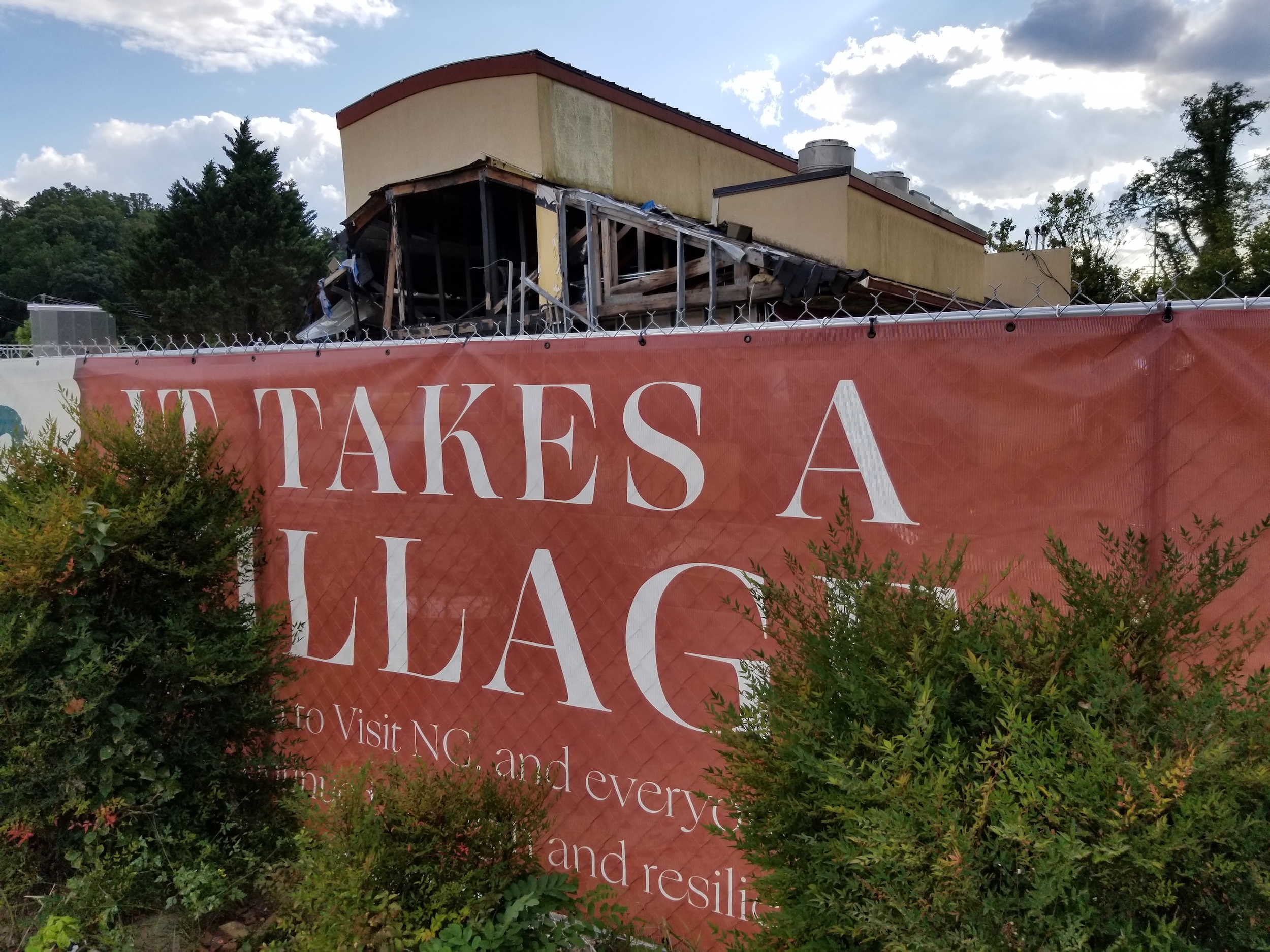
A bizarrely sunny fence wrapping placed by tourism groups around the site of a destroyed building in Biltmore Village. Photo taken in August
Even as the compulsion to sweep things under the rug for the tourists has sadly seeped out from industry p.r. to the wider culture, over the past year other voices have broken through, tearing gaps in the facade.
“Nobody wants to hear us, nobody wants to help us,” Lenora Wells, a resident of Swannanoa, one of the areas hardest hit by the storm, told Asheville city council at its Jan. 14 meeting. “We’re running out of vouchers, we’re going to be homeless, we’ve got people living out of tents.”
“There’s options and there’s funding: use it,” Maryjo Tucker, then living out of a hotel due to Helene’s aftermath, told council at the same meeting. “These people don’t need to be out in the streets…We’re trying to ask for help. If I’m homeless how can I keep a job?”
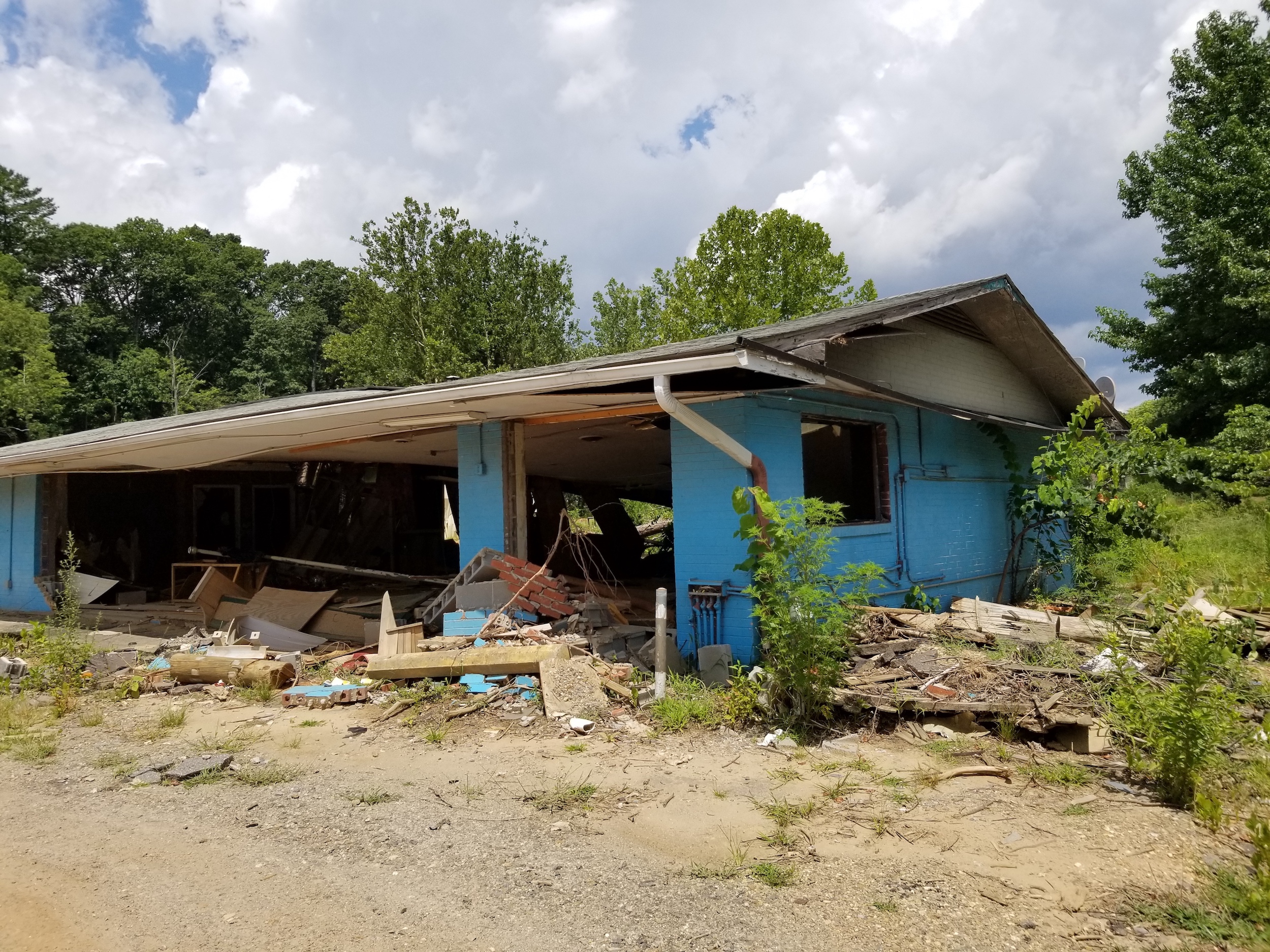
The ruins of the Root Bar, a bar and community spot in East Asheville. Photo taken in July
Tucker made the point that while officials had consistently refused to send adequate rental aid, locals in poverty had thrown together enough funds to keep her in a room.
But those pleas fell on officials whose sympathies, after the storm as before it, are only with the wealthy and powerful. At the same meeting they approved $1.25 million, raised from a tax hike on downtown locals, to a front group controlled by the chamber of commerce to crack down on “anything out of the ordinary” in the city’s core.
Nor was the reality described, in tears and justified anger, by those locals a temporary aftermath.
“I just walked through the River Arts District last night, it still looks like it did last September,” Greyson Kountz said at the June 24 Asheville city council meeting, amid UNCA proposing to destroy an entire, flood-dampening forest to build a stadium. “Broken roads, battered parks, boarded-up stores, dangerous scrap metal, concrete and toppled porta-potties. Prioritizing a 5,000-seat stadium isn’t just out of touch, it’s extremely insulting to students and residents still waiting for basic recovery and support. This city has real work to do.”
“Asheville doesn’t need more shiny developments, we need investment in real recovery.”
“There are constant reminders all around,” Bill Rhodes, Swannanoa resident (and occasional Blade photographer), wrote on Sept. 24, about the tide of recent remembrances. “On my block alone, only 2 out of 5 businesses have reopened. There are people living in tents or campers or yards, and there are still phone poles missing.”
“A row of houses stand empty near a new house being rebuilt. An unending line of dump trucks, always driving too fast and loaded too heavy, spew noise, exhaust and dust. I see all these things and more every time I leave my home.”
Swannanoa Communities Together, which emerged from a major mutual aid response in the aftermath of the storm, recently posted a graph laying out the tide of housing crises that rolled out in Helene’s aftermath.
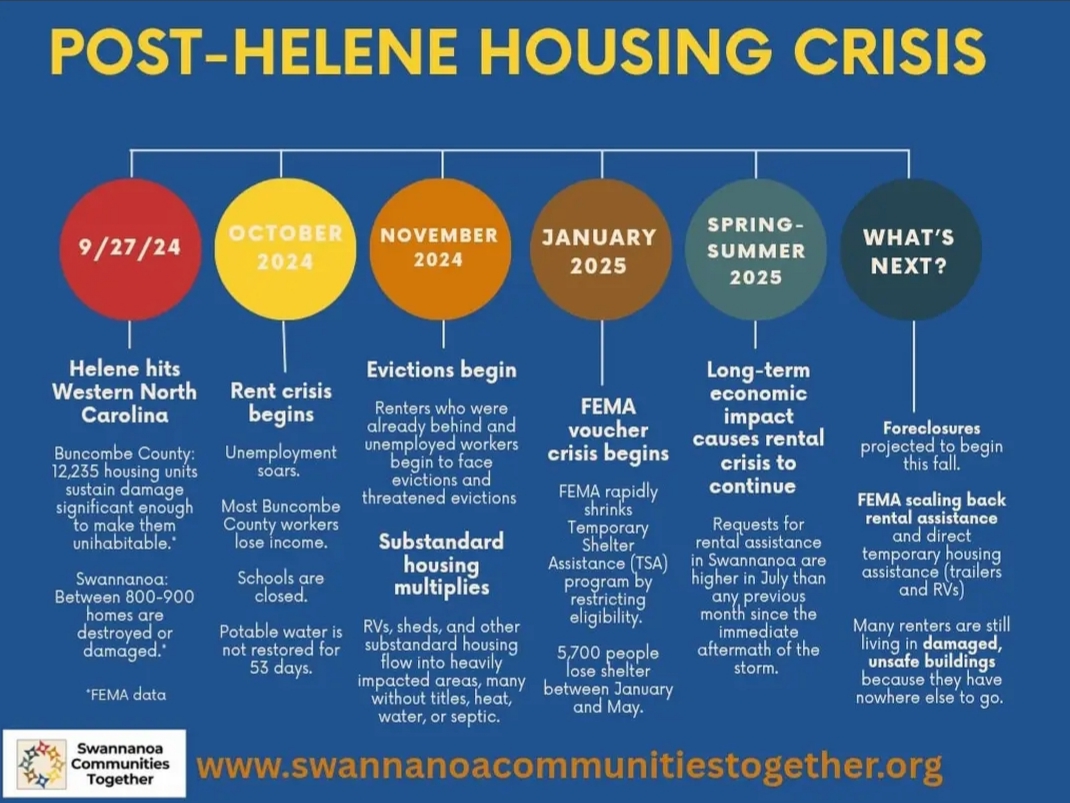
Graphic courtesy of Swannanoa Communities Together
The group advocates for increased shelters for unhoused folks, rental assistance, move-in assistance and more resources for actively connecting people with housing. These are all badly needed, incredibly basic steps that local, state and federal governments have refused to do on any scale approaching what’s needed. Indeed, the opposite has happened. Asheville city hall has tripled down on persecuting the homeless, many kicked out onto the streets by Helene, for daring to ask for help.
After all, they might upset the tourists.
As early as December of last year, as the ominous signs we’d seen in the weeks immediately after the storm grew clearer, I began researching an article on the crisis after the crisis that was taking shape.
Unlike the storm itself this disaster was overwhelmingly manmade, the product of elite predations and a total refusal to face reality.
It quickly became clear that there was far too much here for a single piece. What was needed instead — to give our communities the honesty and depth they deserve — was a series.
This was, is, no easy task. Like the rest of our communities we were reeling. During and after the storm myself and other Blade co-op members did double duty both as journalists and as community members trying to help our neighbors as much as possible.
Some of us are still, over a year later, engaged in mutual aid work. Journalists we’ve worked with on this series have faced their own health issues tied to the storm and its aftermath. The reporters in our co-op are trans, so all this has taken place in an environment of increasing threats to our rights and lives. We are a publication of the working class, written by working class journalists. So we didn’t have tourism dollars, corporate cash or realtors opening their wallets to bankroll us.
Bluntly, we’ve had to put this all together in the middle of poverty, illness, burnout and trauma. But it has, over time, come together.
As the remembrances fade, as the national media once again turns its attention elsewhere, we are left with reality. So in the coming weeks and months we will go in depth, past the marketing, about what we’re still up against and how we got here.
We’ll lay out how decisions by those in power made Helene and its long aftermath even worse than they had to be. We’ll reveal more about those still helping their communities long after the cameras have moved on. We’ll lay out how officials have dedicated their attention to a host of unpopular power grabs, the local variety of the “shock doctrine” seen after disasters around the world.
We’ll look into how of the most successful measures for helping locals are also the least supported. We’ll tell the stories of tenants trying to survive landlord greed amid a disaster and the curdled obsession with elite “safety” fueling an increasingly draconian local police state. All that and more, to reveal something very different from the easy fables of a “recovered” place open for business.
Perhaps most importantly, we’ll look into what the rest of us can do about it.
Our city deserves the truth. It is, in the end, the only path that doesn’t end in another disaster.
Next: A storm as massive as Helene was always going to pose a serious threat. But decisions made by elites — some stretching back decades, some just before the storm, some in its aftermath — ensured its destruction and the human cost were far worse than they had to be. In the second part of The Crisis After the Crisis, we lay out the road to disaster.
—
Blade editor David Forbes is an Asheville journalist with nearly 20 years’ experience. She writes about history, life and, of course, fighting city hall. They live in downtown, where they drink too much tea and scheme for anarchy.
The Asheville Blade is entirely funded by our readers. If you like what we do, donate directly to us on Patreon or make a one-time gift to support our work. Questions? Comments? Email us.