


Behind the marketing, Asheville remains deeply divided two years after Helene, marked by worsening inequality and a government that has made things far, far worse
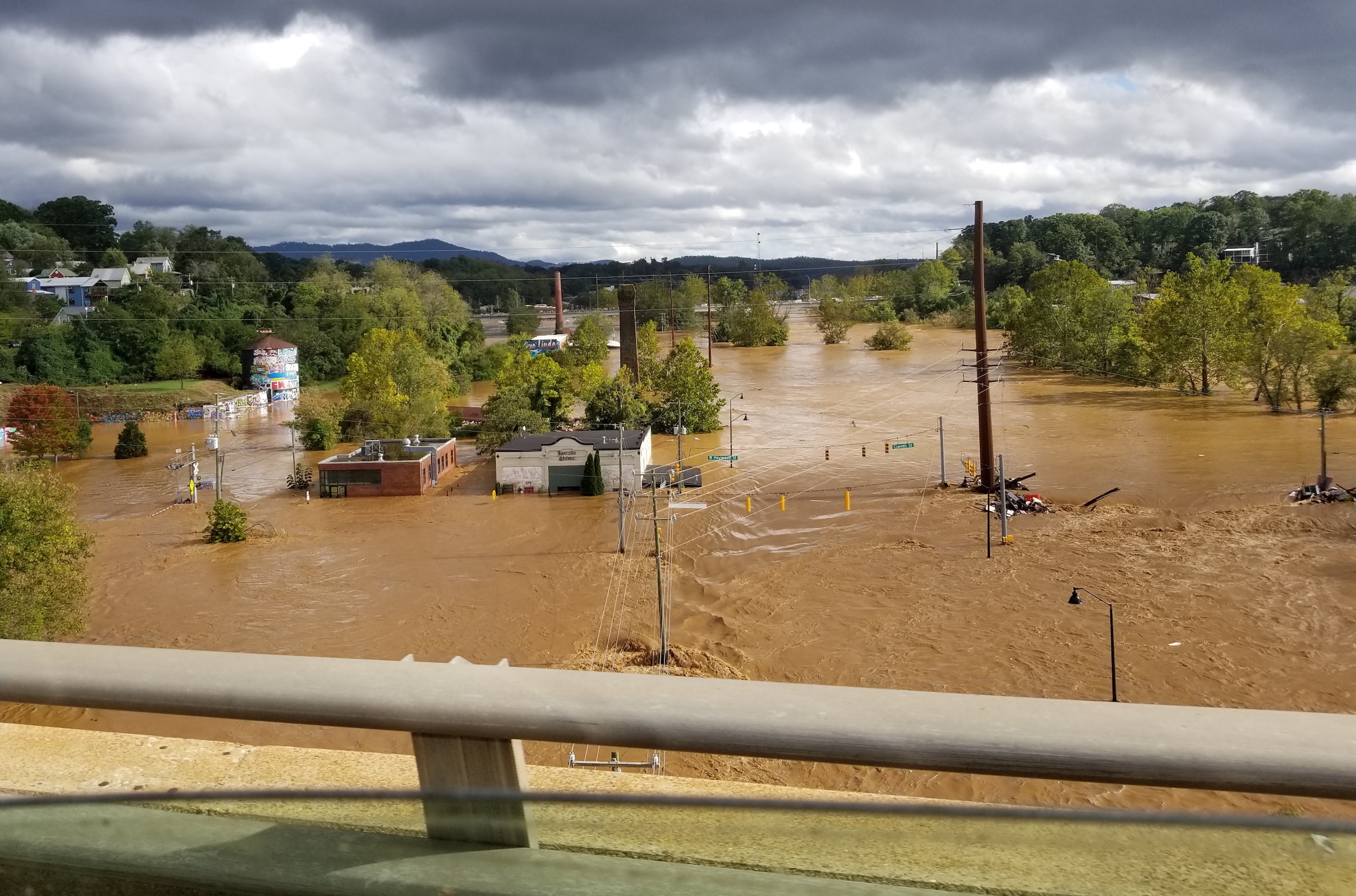
Above: the French Broad River, devastatingly flooded during Helene
Readers, we offer an apology. While over the past months we have kept up our shorter, more immediate coverage on our Patreon, the longform pieces we usually publish here have been sadly absent. Many of the issues we describe in this piece — along with illness, working multiple jobs and family tragedy — have impacted us and the freelancers we work with as well. We are now set to roll out multiple articles over the coming months. We thank y’all for your immense patience and continued support.
— David Forbes
In many ways, Asheville’s status quo has always been built on facades. One of the most unaffordable places in the country lurking under “the happiest place in America,” a “progressive” blue dot with a local government defined by violently racist police, petty cruelty towards dissent and open hatred of the poor.
One of the reasons the Blade exists is to act as a counter to the sheer level of bullshit one encounters about our town.
Since Helene struck, a little over two years ago, the gulf between that facade and reality — and between the wealthy and the rest of us — has widened into an abyss. Their depiction of a recovered, united city ready to welcome tourists bears no resemblance to the realities the vast majority of us here still face on the ground.
A little over a month after the storm, seeing the sharp contrast between those in power making a horrific crisis worse and the heroism displayed by locals, the Blade wrote that “we are two cities.”
“One city is that of communities on the ground and mutual aid, of astonishing resilience and creativity. It’s free hot meals, flush brigades and supply runs,” our statement read. “The other city is a line of cops outside a closed Ingles…It is a town of $5,000 rents and 5,000 airnbnbs, eviction notices, crumbling homes and neglected water lines.”
Two years later we declare so again, with even more grief and fury.
A small glimpse of this reality broke through at the last Asheville city council meeting, on Sept. 22. During the city manager’s report staff played a slick, professionally produced video about what great shape Asheville was in, “turning tragedy into opportunity,” complete with waxing rhapsodic about the $15.5 million in public funds city hall had sent to business owners (struggling renters had no such luck).
But about 15 minutes later, after council breezed through a short agenda and were impatient to get on to whatever it is the gentry do in their spare time, a very different reality pushed to the podium. For the elderly residents of Viewpointe in East Asheville, mostly retired teachers on fixed incomes, the damage of Helene remained all too real.
“Our power lines were strung on trees until this past spring,” Ann Sensibaugh, speaking on behalf of the residents, told council. “We have only asked for your help with the faltering cliff on Azalea Road, where large rocks and trees continue to fall.”
She added that an attorney hired by the residents, with cash they’d scraped together, told them that city hall was already aware of the crumbling landscape and “although you understood this situation, you were unwilling to assist us and make the cliff safe in a heavy traffic area going into the wildlife center and the soccer complex.”
“In fact, the city response was: ‘well, if anything fails we’ll help you clean it up,’” she continued. “We have doggedly followed through with every possible helpmate, from FEMA to the state and federal government and anyone, frankly, who would listen to us.”
“We have written you, we have asked for help, we have been rebuffed at every turn,” she emphasized. “Daily on the news we hear that Asheville is healing. Perhaps it is notable that none of these segments have been filmed in our area of the city.”
Local gentry desperately trying to get wealthy tourists to come back while the cliffs are still crumbling is a neat summary of the post-Helene reality, and the anger so many of us feel at the callousness of those in power in the face of it.
Indeed, the same government Sensibaugh was demanding take action has a post-Helene record that is downright bizarre if genuine recovery was any real priority.
Evictions here resumed before the water was even back on, around the same time business groups started telling the tourists to come back and the bodies of our neighbors were still being found. City hall repeatedly refused public demands by tenants’ groups to put serious funds towards badly-needed rental aid. The results were dire.
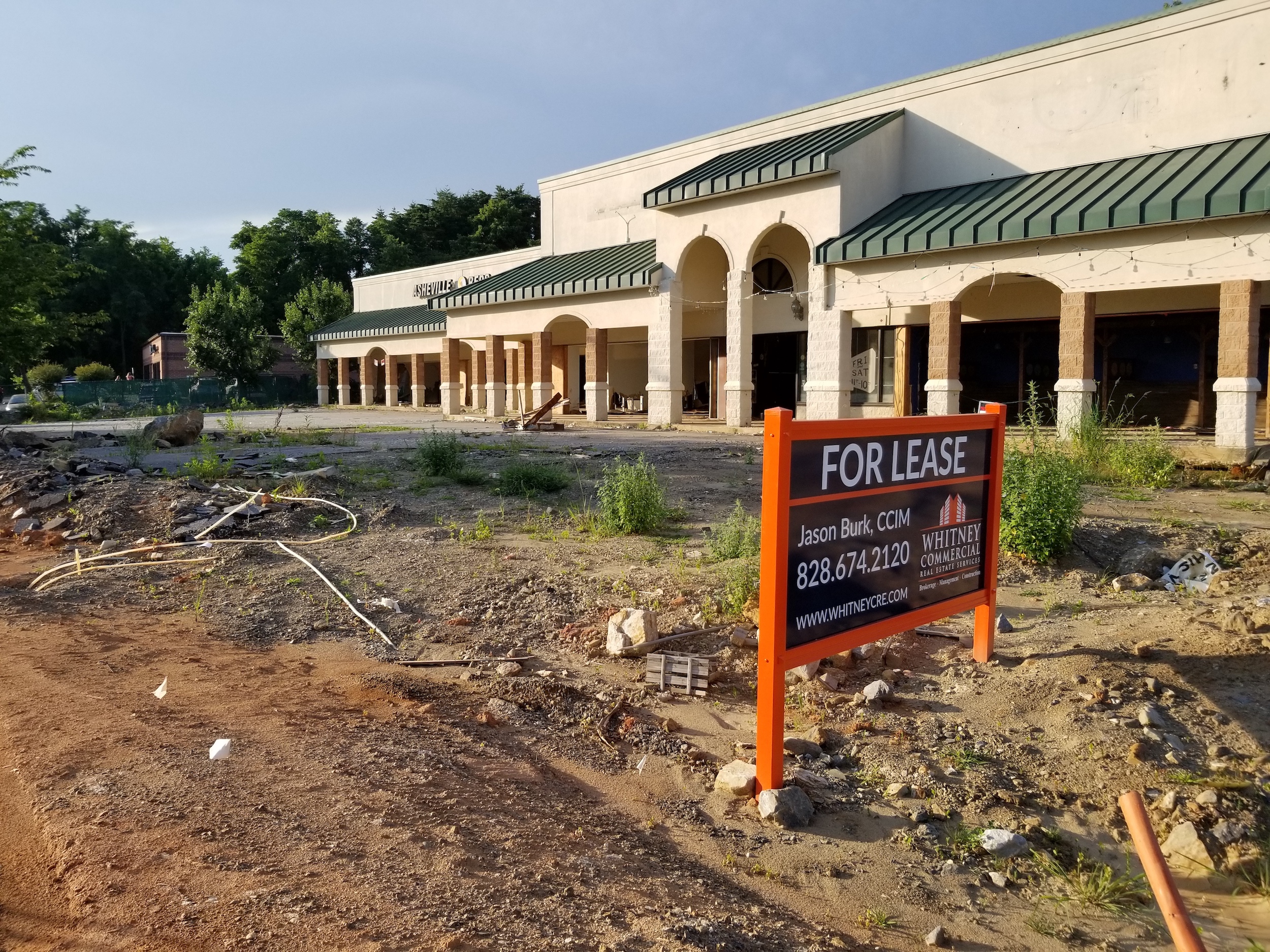
A devastated Tunnel Road commercial property with a shiny ‘For Lease’ sign outside it in the Summer of 2025
No shortage of the 16,000 locals driven out of the area since Helene were from Asheville. Over the past few years, talking to locals who had to leave, the vast majority said that the worst disaster they faced wasn’t the storm but the relentless greed of landlords and bosses well after the floods had receded. Those in power have only recently even acknowledged this as a problem, when it was clear they were running out of workers.
While then-public housing authority CEO Monique Pierre’s infamous remark, in the storm’s aftermath, that “I had to make sure landlords got paid. And they did,” received national attention for its sheer cruelty, the same mentality has consistently dominated local governments’ response in Helene’s aftermath.
Indeed, in February 2025 city council unanimously voted to purge the board that fired Pierre, in the kind of petty retaliation that’s become all too familiar. They were determined to send a clear message that any consequences for figures like her were off the table, no matter how much human misery their actions inflicted. A more typical outcome for the officials whose incompetence — like putting the entire local emergency water reserves across a flood-prone river — made the immediate aftermath of Helene even worse were raises and promotions.
In many ways city hall’s response mirrored the “shock doctrine” seen around the world: use a disaster to further consolidate power in the hands of the elite. In early 2025 they fully imposed the highly unpopular Business Improvement District, a tax on downtown locals that goes to a front group controlled by the chamber of commerce, and stripped out the minimal limitations they’d previously conceded before the storm.
In Helene’s aftermath city officials suspended local citizen boards, then refused to revive them. In summer 2025 council overwhelmingly voted to gut them entirely; a longtime goal of higher-ups angered by their occasional public dissent on issues like policing, hotels and gentrification.
The first major post-Helene city contract, backed by $7.7 million in federal relief funds, was for the golf course. City hall prioritized putting much of a massive pot of FEMA funds to major “capital” projects (the kind that make the city nicer for tourists) rather than badly needed immediate aid and rebuilding. Officials only changed course after a major public outcry, finally redirecting more of the funds towards home repairs.
During these mounting crises Mayor Esther Manheimer started ritually reading city council’s entire rules of decorum at the beginning of each meeting, to chide locals for criticizing her. She was, by contrast, downright obsequious when recording a p.r. spot for infamous for-profit hospital company HCA.
Less than a year after Helene, city hall passed a budget that sharply hiked taxes on struggling locals. Instead of bankrolling recovery, however, this went to pouring even more cash into the police department and to giving city hall higher-ups massive raises on top of their already-bloated salaries. In a twist Kafka would have thought too bizarrely cruel, rather than using their rainy day funds to help locals after a literal massive storm, that tax hike also went to put money back into their reserves and just let it sit there. This was explicitly done to appease wealthy investors.
To add insult to injury, the firefighters whose heroism was so widely lauded saw their already-paltry pay further gutted in the same budget, denied a higher pay hike that most city staff received. Manheimer whined about “hard choices” then returned to her mansion in one of the most expensive neighborhoods in town. Every last member of city council, including her current mayoral rival Kim Roney, voted in lockstep to support her.
This year the same officials induced a self-inflicted budget crisis by hiring 24 more cops while again hiking taxes and cutting services everywhere from neighborhood grants to community centers (higher-ups got another massive raise, naturally). This time it only passed 4-3. Roney, now running for mayor, saw which way the wind was blowing and opposed it. Vice mayor Antanette Mosley and Council member Sage Turner also did so, but because they wanted even more draconian service cuts.
With the numbers of homeless dramatically swelled by Helene survivors, council acted swiftly… to ramp up camp sweeps and increase criminal penalties for begging for food. They’re so hostile to the poor they still haven’t spent millions in homeless aid dollars they received during the height of the pandemic.
The mayor did, however, find time last Fall to personally thank Homeland Security head Kristi Noem, then in the middle of overseeing brutal anti-immigrant raids throughout the country.
It fit a disturbing pattern. Days after the Trump administration took office, city hall proudly announced a collaboration with the new regime that allowed increased drone surveillance of the public. This has gone along with an Orwellian ramping up of surveillance, pouring badly needed resources into more drones, more cameras, more spying, sometimes in cooperation with an openly fascist federal government.
As for the resources the city has received to recover from the storm, the rest of us outside the gentry haven’t, on the whole, seen a goddamn thing. By contrast, when the well-off business owners of Biltmore Village, who overwhelmingly cater to wealthy tourists, whined that city hall wasn’t directly subsidizing their failing businesses officials snapped to attention.
Meanwhile, working class locals are not even safe enjoying a night out. In 2025 the Asheville Police Department pelted multiracial, mostly queer crowds of bargoers on Lexington Avenue with pepper balls merely for gathering on a public street after the bars closed. Earlier this year they did the same on Banks Avenue.
The APD didn’t even bother to claim they were stopping some immediate danger. Instead past incidents of supposed crime in the area, some of them years ago, were excuse enough to hit anyone they didn’t like with chemical weapons. Jackie Stepp, the police commander who oversaw the Lexington crackdowns, was recently promoted to chief.
Those wishing for some reckoning with the city’s vulnerability in an era of escalating climate change also hoped in vain. The consensus emerged among Asheville’s elite that Helene was a one off, with absolutely nothing serious to be learned or, god forbid, changed.
When even the establishment planning think tank the Urban Land Institute finally stated the obvious — that the flood-prone river district was badly overdeveloped and that much of it needed to be relocated to avoid another disaster — city leaders simply refused to listen. The only differing opinion among those running for city council this cycle is that some of them want to go even faster in restoring the pre-storm status quo.
Today, there are still locals crammed into older, crumbling housing that’s particularly vulnerable to storms and flooding. Meanwhile newer homes and apartments on higher ground sit vacant as investment properties or airbnbs. This is that same situation that killed good people when Helene hit and unless something drastically changes, will do so again.
Plenty of attention, not wrongly, has gone to the pittance in resources delivered here by the state and federal governments. While these are very real evils, that does not change the fact that the government closest to home, in our city, is a disaster in its own right, major architects of the crisis after the crisis that still defines our everyday lives.
Two years later, city government is far more obsessed with spying on the people it supposedly represents than lifting a finger to keep the still storm-ravaged land from literally collapsing under their feet.
Helene is often referred to as an apocalyptic event. That is certainly true in the sense of the devastation it caused. But it is also accurate in the original, older sense of the word, of a “rending of the veil,” revealing what lay behind the old facades.
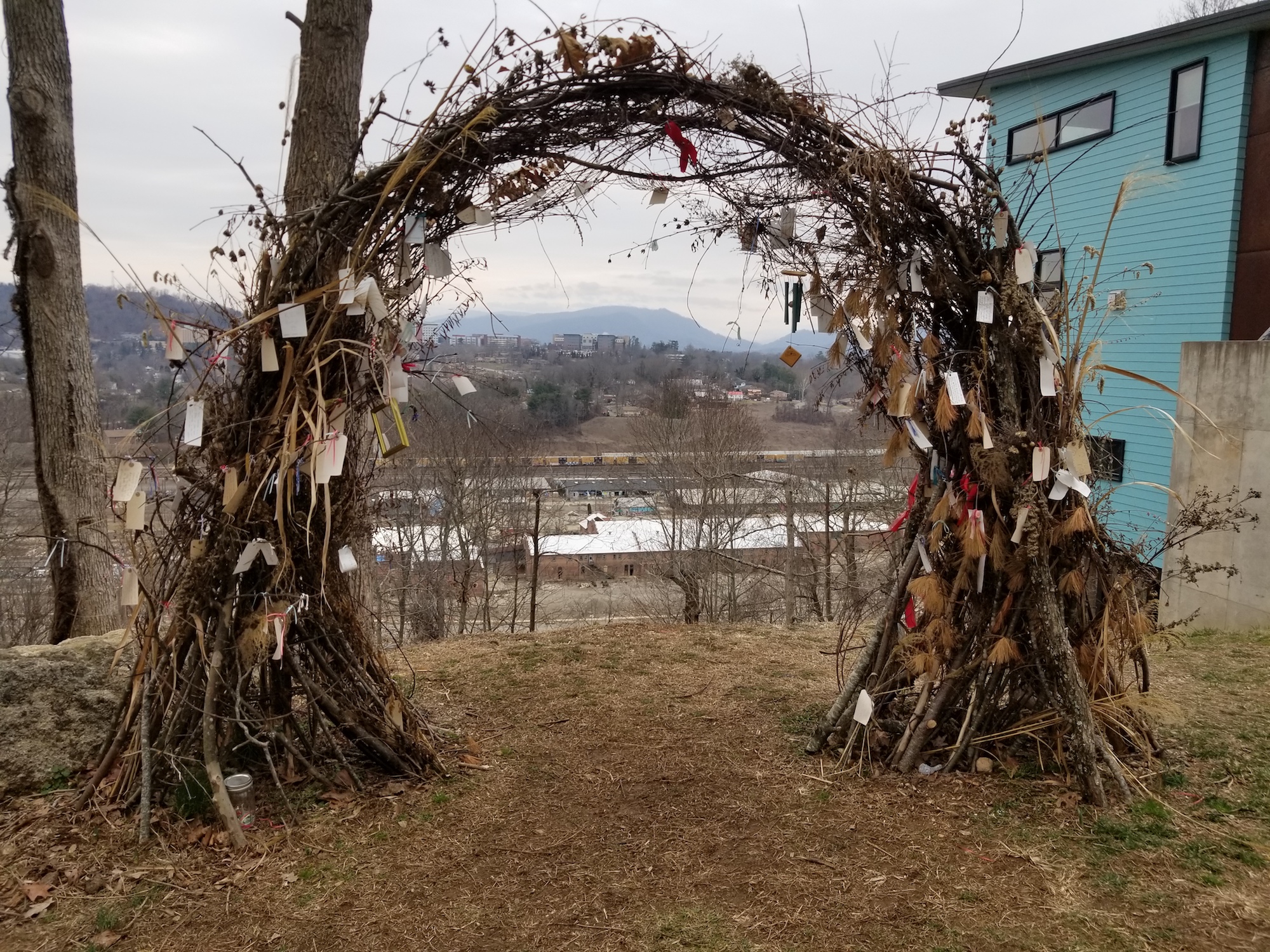
The ‘grief gate,’ an artwork on a side street in West Asheville where locals wrote their griefs and hopes after Helene, taken Spring of 2025
“It feels like we’re being punished for surviving,” I heard from one local after they had to pack up and move for the third time since the storm.
More than once, I have heard people struggling to make ends meet here vent that they were better off in the weeks after Helene, hard as they were. At least then there was free food and people were mobilizing to help each other.
This is the other Asheville, and it happens to be where most of us live. If the city in the promo spots is a shiny, smiling place, unified and rapidly recovering, our city is still struck by grief, trauma and precarity. The gentry’s city is also marked by greed and a dogmatic refusal to face the truth. Ours is defined by communal care and realities harsh enough that we couldn’t ignore them if we tried.
For them Asheville is an asset — Helene’s aftermath removed any doubt of that — to be wrung for every dollar they can get. For us, this is home.
There is, in a ragged way, strength in that. Though those in power — who with a handful of notable exceptions proved themselves useless or actively detrimental — have tried to co-opt it into their narrative of a united city under their leadership, the grassroots response that saved so many was overwhelmingly community-driven. It was, in the best possible way, anarchic.
It also didn’t stop. Some of those networks have since become groups like Swannanoa Communities Together. Many remained more informal, but continued to help out their neighbors long after the cameras left. I was still regularly helping to arrange supplies for struggling Helene survivors less than a year ago. I still do, from time to time.
It’s also taken a very real toll, even for those of us who were fortunate not to lose our homes in either Helene itself or the tidal wave of evictions that followed.
Speaking personally, the physical and mental burnout inflicted in the months after still hasn’t entirely faded, two years later (escalating anti-trans bigotry locally hasn’t helped). Struggles with exhaustion are just heavier than they used to be. This isn’t to single out my own experience, but because I’m far, far from the only one.
The sense of solidarity many of us felt in the storm also hasn’t gone away. Though it’s taken its share of hits, it still shows up in surprising ways.
When city council sought to use federal dollars to massively expand its surveillance networks, they were surprised by the massive public backlash. The same went for the corrupt budget they pushed through earlier this year. They reluctantly conceded taking down Flock cameras (some of them already vandalized) and additional protections against slumlords (though trying to subtly weaken them) not out of the goodness of their hearts, but due to increasing fear of an angry public.
Local officials like Manheimer and Council member Bo Hess — who are particularly contemptuous towards most locals — are widely hated, the targets of mockery in a way I’ve rarely seen before in over 20 years of covering government here.
Ironically, the fact the elite response has been so utterly awful has strengthened the fragile but real sense of solidarity among the rest of us. Far fewer people put their hopes in those in power, increasingly looking beside them rather than up at a dais.
More and more of us realize, every day, that it is us against them.
Just over two years ago, the storm hit our city. In the days afterwards we started digging ourselves out of the wreckage. We are doing so still.
—
Blade editor David Forbes is an Asheville journalist with over 20 years’ experience. She writes about history, life and, of course, fighting city hall. They live in downtown, where they drink too much tea and scheme for anarchy.
The Asheville Blade is entirely funded by our readers. If you like what we do, donate directly to us on Patreon or make a one-time gift to support our work. Questions? Comments? Email us.